The 10 Best Cherry Blossom Trees to Know, See and Love
By JILL BROOKE
10 Best Cherry Blossom Trees You Should Know
Who doesn’t love cherry blossom trees which are blooming in late March and April. Here, you’ll discover the 10 best varieties to know and adore and places to see them.
The three best places to see cherry blossom trees are in Essex Country Brook Park near Newark, New Jersey, Washington D.C., and Macon, Georgia, which is known as the “Cherry Blossom Capital of the World” and has around 300,000–350,000 Yoshino Cherry Trees.
All three places use these natural wonders as catnip to attract millions of visitors. Two of the three places got their cherry blossom trees and traditions as a result of generous gifts.
Three Best Places in U.S. To See Cherry Blossom Trees
1.Essex County Parks in New Jersey is home to over 5,000 trees in 18 varieties, making Branch Brook Park home to the largest cherry tree collection in the country.Most of the cherry blossom trees were a gift to Newark, New Jersey in 1927 from Caroline Bamberger Fuld, who donated 2,000 cherry blossom trees to the park in memory of her beloved late, sister Mrs. Felix Fuld.
Branch Brook Park was also designed by the amazing Frederick Law Olmsted Sr., who also is the genius behind New York’s Central Park, which also has some cherry blossom trees as well.
Essex County Parks also hosts the annual Cherry Blossom Festival, which this year takes place from April 5-13, 2025, with events like a Challenge Bike Race, Cherry Blossom 10K Run, and Bloomfest.
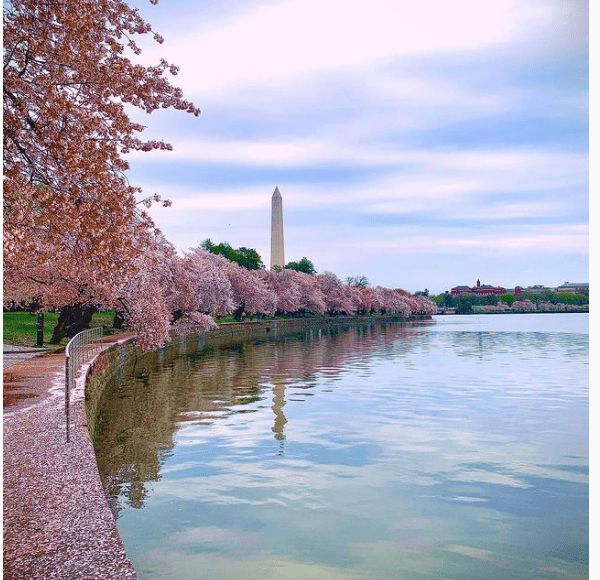
2.The famous cherry blossom trees in Washington D.C. along the Tidal Basin were originally gifted from Japan to the U.S. in 1912 as a symbol of renewal and friendship.
First Lady Helen “Nellie” Taft played a crucial role in bringing cherry blossoms to Washington D.C. by initiating a plan to plant Japanese cherry trees along the Tidal Basin, which led to a gift of 3,020 trees from the city of Tokyo in 1912.
Helen Taft, who had traveled to Japan, when her husband, President William Taft, was Secretary of Defense under President Theordore Roosevelt. She was captivated by the beauty of cherry blossoms and envisioned them as a beautiful addition to Washington D.C.’s landscape, specifically Potomac Park. Her success is now called “landscape diplomacy.”
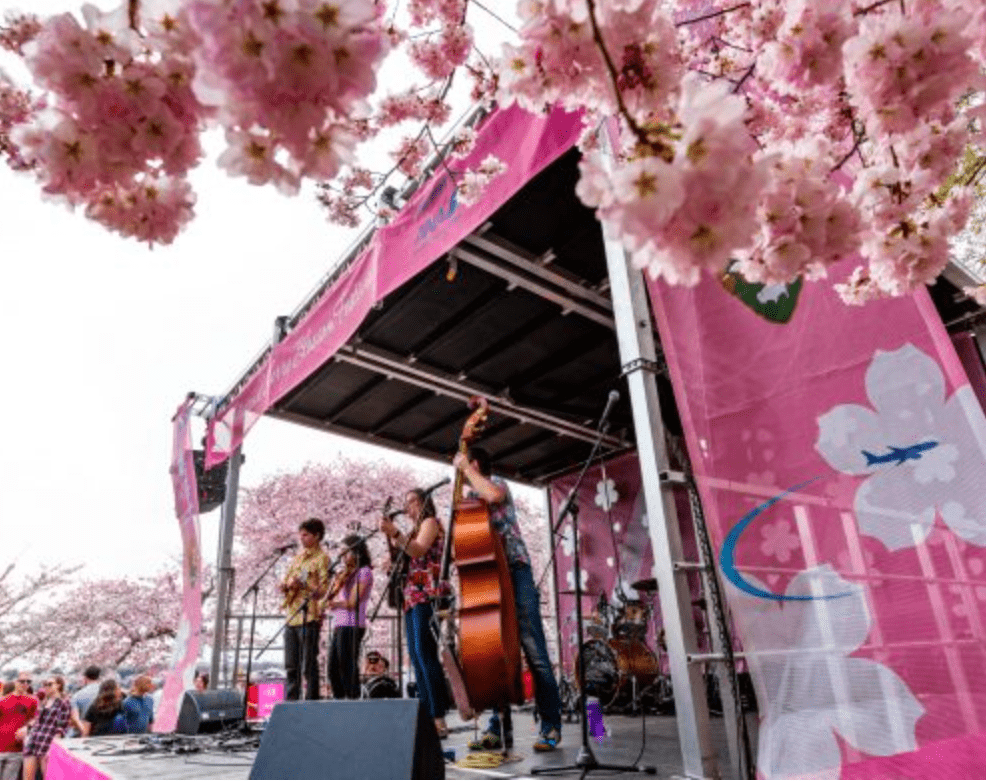
As part of the National Cherry Blossom Festival, Washington D.C. offers many inspired cherry blossom activities, including art shows, live performances, and lectures over the next few weeks. The festival concludes on April 13th.
3. Other notable locations for cherry blossoms include Macon, Georgia, which is known as the “Cherry Blossom Capital of the World” and has around 300,000–350,000 Yoshino Cherry Trees. Since it’s a warmer climate than Washington D.C. or New Jersey, most of the blooms take place in March as well as the celebrations.
Macon, Georgia, didn’t receive cherry blossoms as a gift from Japan like Washington, D.C., but instead, the trees were discovered and propagated locally by a citizen named William A. Fickling, Sr. who found a Yoshino cherry tree in his backyard in 1949. Sharing with others led to the trees spreading throughout Macon, and becoming community efforts to plant more.
Out on the West Coast, Salem, Oregon had its Cherry Blossom Festival. Portland, Boston, Nashville and St. Louis each have a Cherry Blossom Festival. St. Louis with a mere 40 pale pink Yoshino trees still attracts appreciative crowds. Hawaii also has one.
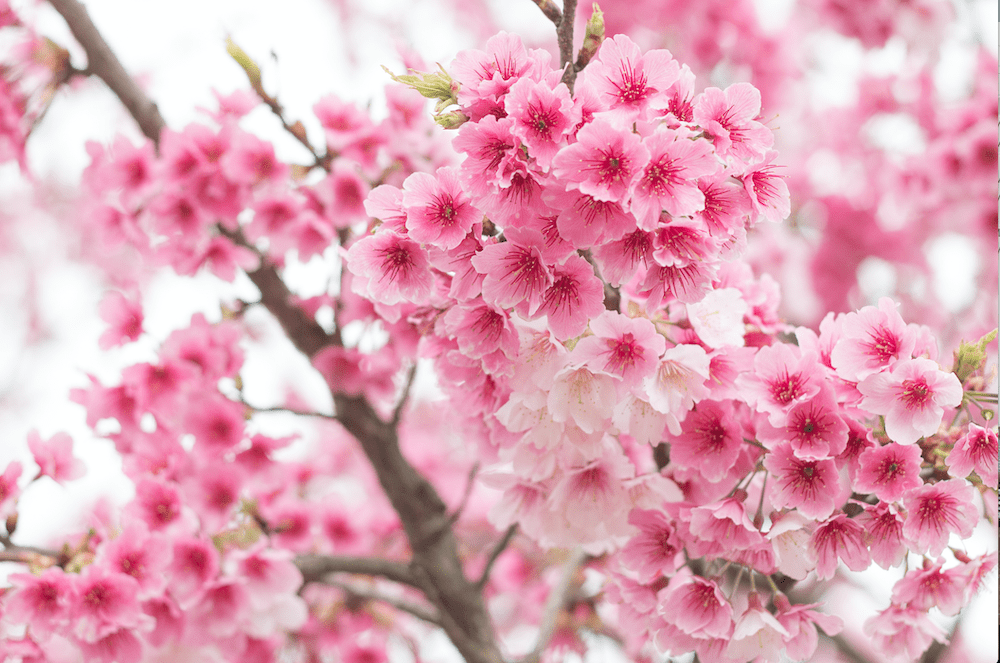
Like siblings and cousins in a family, there are many different types of cherry trees to explore. Since the National Parks Services cares for the 3,000 cherry blossom trees that announce spring in Washington D.C., here is their tutorial on the trees.
After all, cherry blossoms are truly special for many reasons. Did you know that in a study from South Korea’s Forest Research Institute, a 25-year-old cherry tree ca absorb about 20 pounds of emissions each year so this. beautiful tree also helps combat climate change in its ability to offset greenhouse gases. Another reason to love them, right?
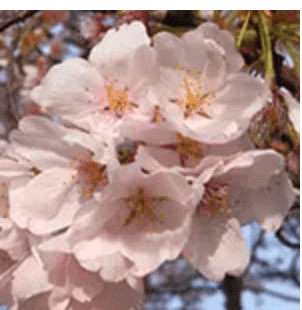
Mostly Yoshino cherry trees circle the Tidal Basin and spill north onto the Washington Monument grounds which most people know for their lush fluffy blossoms. Yoshino cherries produce many single white blossoms that create the effect of white clouds around the Tidal Basin. Known as Somei-yoshino in Japan, Yoshinos are a hybrid first introduced in Tokyo in 1872. Now, Yoshinos are one of the most popular cultivated flowering cherry trees.
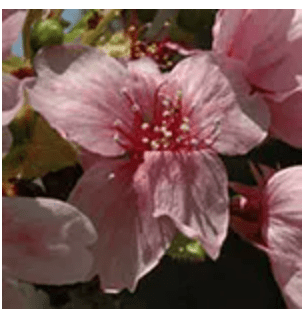
Mingled with the Yoshino trees are a small number of Akebono cherry trees, a mutation of the Yoshino cherry with single, pale pink blossoms. Akebono trees were introduced by W. B. Clarke of California in 1920. The Akebono cherry trees flower at the same time as the Yoshino, providing a tint of pink in the early stages of the peak bloom.
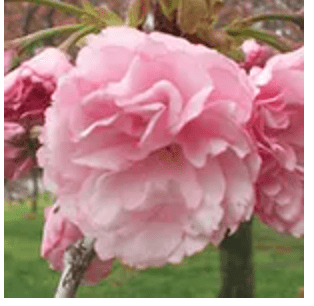
Kwanzan cherry trees are named after a mountain in Japan. Kwanzan cherry trees primarily grow in East Potomac Park. Coming into bloom two weeks later than the Yoshino, the upright Kwanzan branches produce heavy clusters of pink double blossoms.
In East Potomac Park, you’ll also find Fugenzo and Shirofugen trees. Fugenzo cherry trees blossom with double, rosy pink flowers. Shirofugen trees blossom with double flowers as well, white when the blossoms are open and aging to pink. Fugenzo cherry trees were originally planted along the Potomac River from the present site of the Lincoln Memorial south toward East Potomac Park, but gradually disappeared there.
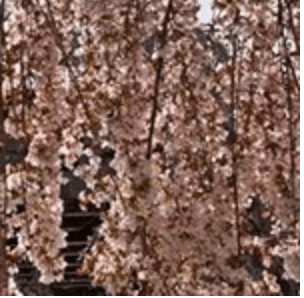
The Weeping Japanese Cherry, sometimes called the Higan Cherry, is interspersed between the Yoshino, Akebono, and Kwanzan cherry trees. The flowers of the Weeping Cherry vary, blossoming as single or double flowers and in colors from dark pink to white. Weeping Japanese cherry trees flower about a week before the Yoshino trees.
Other tree types found in the park include the Autumn Flowering Cherry with semi-double, pink flowers, the Sargent Cherry with single, deep pink flowers, the Usuzumi Cherry with white-grey flowers, and the Takesimensis Cherry with clusters of white flowers.
Comparison Chart of the Best Cherry Blossom Trees and Varieties
| Image | Botanical Name | % in Park | Height & Habit | Flowers | Zone | Notes |
|---|---|---|---|---|---|---|
 |
Prunus × yedoensis | 70% | 30–50 ft, round-topped and wide spreading | White, almond-scented, clusters of 2–5 | Zone 6 (0 to -10°F) | Beloved Japanese hybrid first seen in Tokyo, 1872 |
 |
Prunus serrulata ‘Kwanzan’ | 13% | 30 ft, upright, rounded crown | Double pink, 30 petals, pendulous clusters | Zone 5 (-10 to -20°F) | Ornamental and showy, blooms later than Yoshino |
 |
Prunus × yedoensis ‘Akebono’ | 3% | 30–50 ft, round-topped | Single pale pink fading to white | Zone 6 (0 to -10°F) | Fading in popularity; replaced by ‘Afterglow’ |
 |
Prunus subhirtella var. pendula | 2.4% | 20–40 ft, graceful weeping crown | Single or double pink, variable by cultivar | Zone 5 (-10 to -20°F) | Popular ornamental with many varieties |
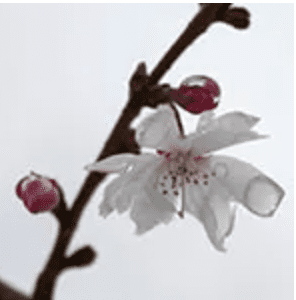 |
Prunus takesimensis | 5% | 30–40 ft, upright spreading | White, in large clusters | Zone 6 (0 to -10°F) | Moisture-tolerant; native to wet habitats |
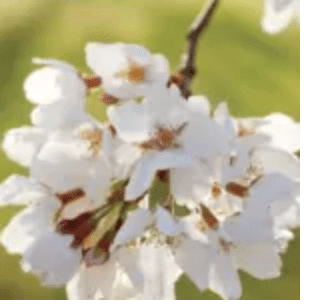 |
Prunus subhirtella var. autumnalis | 3% | 25–30 ft, rounded shape | Pink semi-double, blooms fall & spring | Zone 4 (-20 to -30°F) | Blooms sporadically in winter during warm spells |
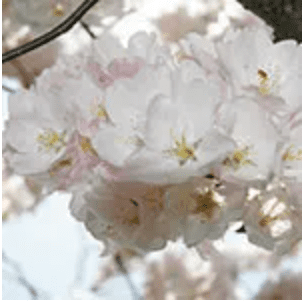 |
Prunus spachiana f. ascendens | 1.3% | Up to 40 ft, ascending crown | White turning to grey | Zone 6 (0 to -10°F) | Descendant of Japan’s 1,400+ year-old Usuzumi tree |
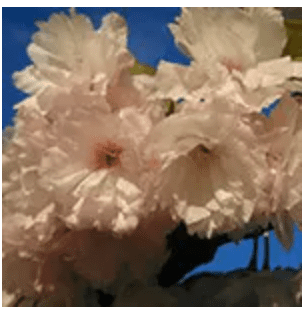 |
Prunus sargentii | <1% | 40–50 ft, upright and spreading | Single deep pink, in clusters | Zone 4 (-20 to -30°F) | Hardy and colorful, but rare in park |
 |
Prunus serrulata ‘Shirofugen’ | <1% | 20–25 ft, flat-topped and wide | Double, white aging to pink | Zone 5 (-10 to -20°F) | Elegant late bloomer with color-changing flowers |
 |
Prunus × ‘Okame’ | <1% | 25 ft tall, 20 ft wide | Pink, semi-double, earliest to bloom | Zone 5–6 (-20 to -10°F) | Marks the beginning of cherry blossom season |
Best Cherry Blossom Trees by Appearance, Bloom, and Climate Zone
1) Yoshino Cherry (Prunus x yedoenis) – Approximately 70% of the total number of cherry trees in the park.
Habit: a round topped, wide spreading tree that reaches 30 to 50 feet at maturity.
Flowers: white, single in clusters of 2 to 5, and almond-scented.
History: This hybrid cherry of unknown Japanese origin was first noticed in Tokyo about 1872 and is now one of the favorite cultivated cherry trees of Japan. Zone: Hardy to USDA Hardiness Zone 6: Range of average minimum temperature 0 to -10 degrees Fahrenheit.
2) Kwanzan Cherry (Prunus serrulata “Kwanzan”) Approximately 13% of the cherry trees in the park.
Habit: an upright-spreading tree to 30 feet, with a rounded crown and stiff ascending branches. Wider than tall at maturity.
Flowers: double, with about 30 petals, in pendulous clusters of 3 to 5, sometimes more, clear pink and fading but small, up to 2½ inches across, with many more or less petaloid stamens often partly concealing the two green leafy carpels which protrude from the center of the flower.
Zone: Hardy to USDA Hardiness Zone 5: Range of average minimum temperature -10 to -20 degrees Fahrenheit.
3) Akebono Cherry (Prunus x yedoensis “Akebono”) Approximately 3% of the cherry trees in the park.
Habit: a round topped, wide spreading tree that can reach 30 to 50 feet at maturity.
Flowers: single, pale pink that fade to white, in clusters of 2 to 5.
History: This cultivar is losing popularity in the nursery trade and is being replaced with the cultivar Afterglow (Prunus x yedoensis “Afterglow”) which has pink blossoms that are deeper in color and do not fade.
Zone: Hardy to USDA Hardiness Zone 6: Range of average minimum temperature 0 to -10 degrees Fahrenheit.
4) Weeping Cherry (Prunus Subhirtella var. pendula) Approximately 2.4% of cherry trees in the park.
Habit: tree 20 to 40 feet high, with a round-flattened, gracefully, weeping crown. Usually grafted about 6 feet on the understock.
Flowers: single, pink. This variety is very variable and select cultivars differ in form and color. (i.e., “Pendula Rosea”, single deep pink flowers; “Pendula Plena Rosea”, double, pink flowers; “Pendula Alba”, single, white flowers; “Rosey Cloud”, double, bright pink flowers; “Snowfozam”, single, white flowers etc.). Zone: Hardy to USDA Hardiness Zone 5: Range of Average minimum temperature -10 to -20 degrees Fahrenheit.
5) Takesimensis Cherry (Prunus takesimensis) Approximately 5% of cherry trees in the park.
Habit: an upright spreading tree that can reach 30-40 ft. at maturity.
Flowers: white, in large clusters with short pedicels.
History: This species is known to grow in wet locations in its native habitat and is currently being tested in East Potomac Park for tolerance to excessive moisture.
Zone: Hardy to USDA Hardiness Zone 6: Range of Average minimum temperature 0 to -10 degrees Fahrenheit.
6) Autumn Flowering Cherry (Prunus subhirtella var. autumnalis) Approximately 3% of cherry trees in the park.
Habit: an upright rounded tree to 25-30 ft. with a 15-20 ft. spread.
Flowers: semi-double, pink. During warm periods in the fall and winter months they will open sporadically and then fully flower the following spring.
Zone: Hardy to USDA Hardiness Zone 4: Range of average minimum temperature -20 to -30 degrees Fahrenheit.
7) Usuzumi Cherry (Prunus spachiana f. ascendens) Approximately 1.3% of cherry trees in the park.
Habit: tree to 40 ft. with a round, gracefully ascending crown.
Flowers: single, white, truning to grey.
History: The trees in West Potomac Park are propagations from the 1,400+ year old Usuzumi tree growing in the village of Itasho Neo, in Gifu Prefecture of Japan. It is said that that the 26th Emporer Keitai of Japan planted this tree to celebrate his ascension to the throne. The Usuzumi tree was declared a National Treasure of Japan in 1922.
Zone: Hardy to USDA Hardiness Zone 6: Range of average minimum temperature 0 to -10 degrees Fahrenheit.
8) Sargent Cherry (Prunus sargentii) Less than 1% of cherry trees in the park.
Habit: Upright to 40-50 ft. with spreading branches approximately equal to height.
Flowers: single, deep pink, in clusters.
Zone: Hardy to USDA Hardiness Zone 4: Range of Average minimum temperature -20 to -30 degrees Fahrenheit.
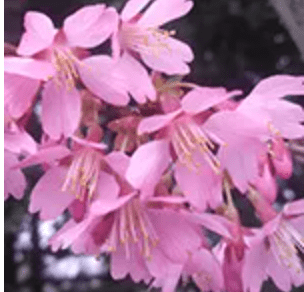
9) Shirofugen Cherry (Prunus serulata “Shirofugen”) Less than 1% of cherry trees in the park.
Habit: a flat topped, wide spreading tree to 20-25 ft.
Flowers: double, in large clusters, white when open aging to pink.
Zone: Hardy to USDA Hardiness Zone 5: Range of Average minimum temperature -10 to -20 degrees Fahrenheit.
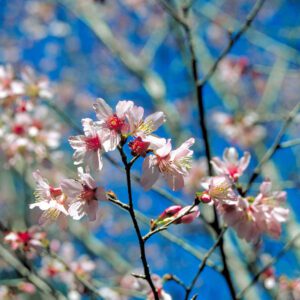
10) Okame Cherry (Prunus x “Okame”) Less than 1% of cherry trees in the park.
Habit: Upright tree to 25 ft. with a 20 ft. spread.
Flowers: semi-double, pink. The earliest flowering cherry.
Zone: USDA Hardiness Zone 5: Range of Average minimum temperature -10 to -20 degrees Fahrenheit. USDA Hardiness Zone 6: Range of Average minimum temperature 0 to -10 degrees Fahrenheit.
More Facts on Washington D.C. Cherry Blossoms Causing Diplomatic Tensions
The Cherry Blossom Festival in Washington, DC, began when the City of Tokyo, first in 1909, offered to donate 2,000 cherry trees to beautify the city. The first shipment arrived in Seattle in 1910 and was transported to DC, where, when the trees were unloaded, it was discovered they were diseased. Yes, there was a Department of Agriculture back then, and they found nematodes and insects they did not want to infect American trees. President Taft gave the difficult order and the 2,000 trees were immediately burned.
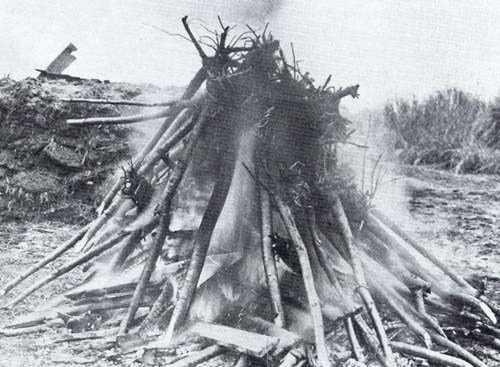 Burning of diseased cherry trees, courtesy of the U.S. National Arboretum
It did not cause an international incident, but it set the planting of the cherry trees back a bit. It was 1912 before another crop was gathered, and this time 3,020 cherry trees of 11 different varieties had been grafted onto a special root stock in Japan, then shipped to Washington and transported cross country, in insulated freight cars to Washington DC.
They were planted in 1912. A triumvirate of women – Nellie Taft, Iwa Chinda of Japan, and Eliza Ruhamah Scidmore, the woman who had long campaigned for the new capital of the country to have its own grove of cherry trees – were there when the first two Yoshino cherry trees were ceremonially planted at the Tidal Basin, on March 27, 1912 in the presence of the Japanese Ambassador, to signal “friendship between the U.S. and Japan.”
These trees have been a symbol of friendship ever since – as well as beauty.