Pro Tips for Crafting Sustainable Flower Arrangements

Sustainable Flower Arrangements
Creating sustainable flower arrangements is easier than you might think. With the right materials, a positive attitude, and a few pro tips to guide you, the process can become both rewarding and enjoyable.
“It’s all about changing the way you approach flowers and arranging them,” says Kelly Shore, the owner of Petals by the Shore and a national advocate for sustainable flowers. While foam may seem like the easier option, alternatives like chicken wire and pin frogs become viable with practice, though they come with their own challenges.
For flower enthusiasts, sustainability often feels like a natural extension of their craft. Flowers are deeply connected to the Earth and embody the essence of life itself. Those who live and breathe the floral world care passionately about nature. After all, florists choose a profession that demands a combination of physical labor, mechanical expertise, and time—alongside boundless creativity and a deep appreciation for the diverse textures and types of flowers nature provides.
However, the truth is that until recently, practical and environmentally friendly options for sustainable flower arrangements have been limited, leaving floral lovers searching for effective solutions.
To bring clarity, it’s useful to understand the distinction between “eco-friendly” and “sustainable.” While these terms overlap, “eco-friendly” specifically focuses on reducing waste through recycling, composting, and using biodegradable materials. On the other hand, “sustainable” refers to minimizing the depletion of natural resources and striving to regenerate what is used—both essential practices for environmentally conscious floral designs.
To make your journey easier, here are pro tips to help you create stunning and sustainable flower arrangements.
FINDING LOCALLY SOURCED FLOWERS
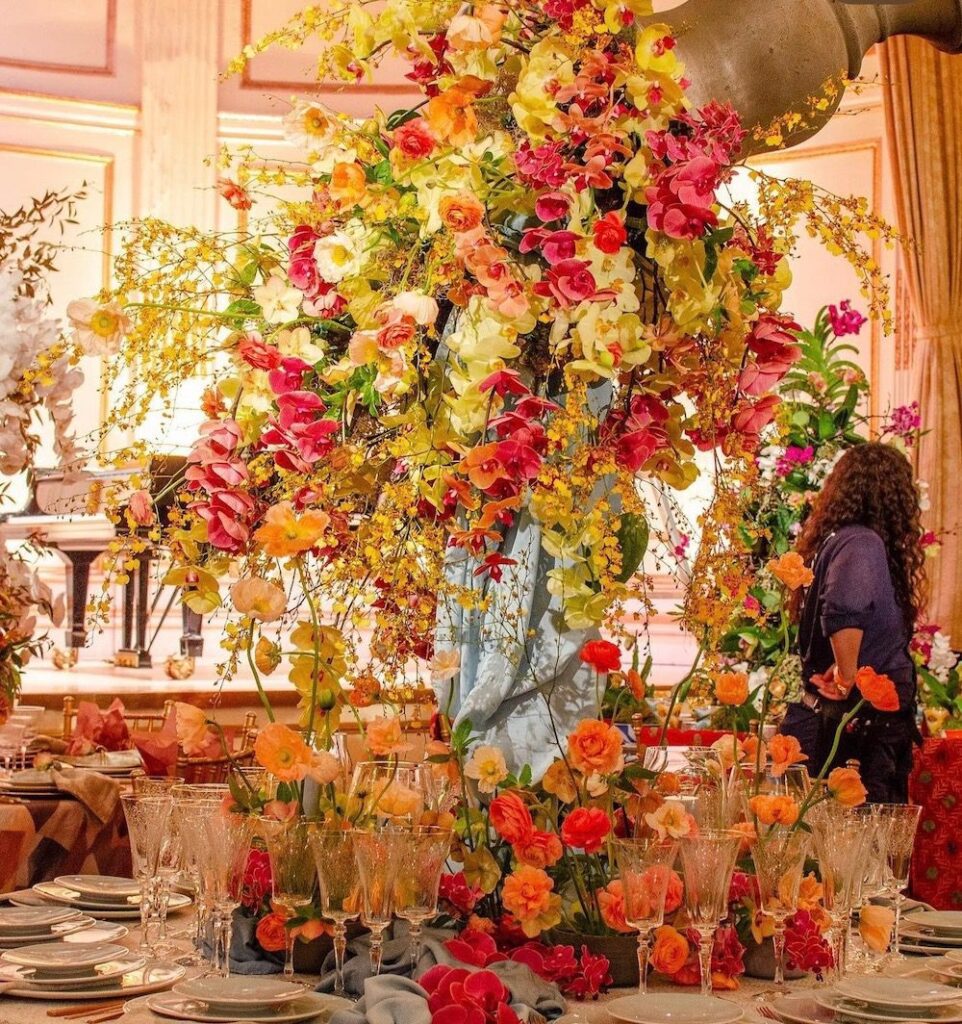
T.J. McGrath was doing an event for the New York Botanical Garden’s orchid show.
So how do you get sustainable flowers in the middle of winter? “Since orchids were the theme of the night, NJ orchid grower Taida Orchids made that possible for me,” says McGrath. “The orchids paired beautifully with Hautau and Son’s, a three-generation old NJ family-owned farm, seasonal offering of poppies ranunculus and hellebore.” Furthermore, he says proudly, he “achieved 75% local when initially I thought it would be much less.” Over time, you collect sources. First, ask local farmers in your area who grows sustainable flowers. Many advertise it. Also before a wedding, seek local florists and ask for flowers to be grown for your event.
Because we all seek perfection but also must be practical. I am now giving you an additional present. Here are some of the newest and best eco-friendly and sustainable products on the market so you can decide what works for you and your abilities.
VESSELS, POTS AND MORE TEXTURES FOR YOUR SUSTAINABLE FLOWER ARRANGEMENTS
Accent Decor is always on the cutting edge of design and practicality. Like many companies, it is continuously increasing its eco-friendly and sustainable offerings. Florists applaud the Capricorn, Cassio, Elijah and Orion compotes, which are designed specifically for eco-friendly design mechanics and hold lots of water. Renowned Ann Arbor, Mich.-based floral designer, educator and author Susan McLeary likes Accent Décor’s Harlow stands and footed bowls, as well, which enable elevated designs. The shape allows for chicken wire vs. foam.
But it is not only the shape of the containers that is resonating but how they are composed. “In our upcoming January launch, we’re introducing a recycled terra-cotta collection,” says Caroline Woods, Accent Decor’s product design manager. “The recycling process involves taking dried terra-cotta scraps, grinding them down and mixing them into fresh clay, minimizing waste while creating beautiful, textured pieces like bowls and pots with saucers.”

BUY POTS THAT DECOMPOSE
Proven Winners, a well-known producer of garden plants, has also been innovative in creating eco-friendly pots for growers, garden centers and consumers. The company now offers 100 percent plastic-free compostable Eco+ Containers that are made in Minnesota. They are made from polylactic acid (PLA), which is formulated of natural sugars derived from U.S.-grown corn and sugar beet plant parts—parts that are not eaten. The pots have nutrients like calcium, nitrogen and phosphorus built in- which are also great for planting if you use the flowers outside. The entire container can be planted in the ground where, as it breaks down, those nutrients are slowly released to the plants over time, helping them grow bigger and stronger.
The numbers are meaningful. As Marshall Dirks, vice president of marketing at Proven Winners, reveals, “In 2024 so far, we have eliminated 1 million pounds of plastic with our Eco+ Containers, and we expect to double that figure for 2025,” he says. Furthermore, Proven Winners has also introduced containers and plant tags made from 100 percent recycled plastic.
Keep in mind that for all these advancements, the companies have also invested considerable time and money into products that don’t produce the results they may want. I asked Dirks for an example. He recalls an attempt of using chicken feathers to create containers. Good idea, but the pots would break by the time they hit retail stores. However, he says, it’s all part of the global effort to be more sustainable in lots of ways and find products for the market that do work and endure.
ARCHWAY DESIGNS AND FLORAL INSTALLATIONS
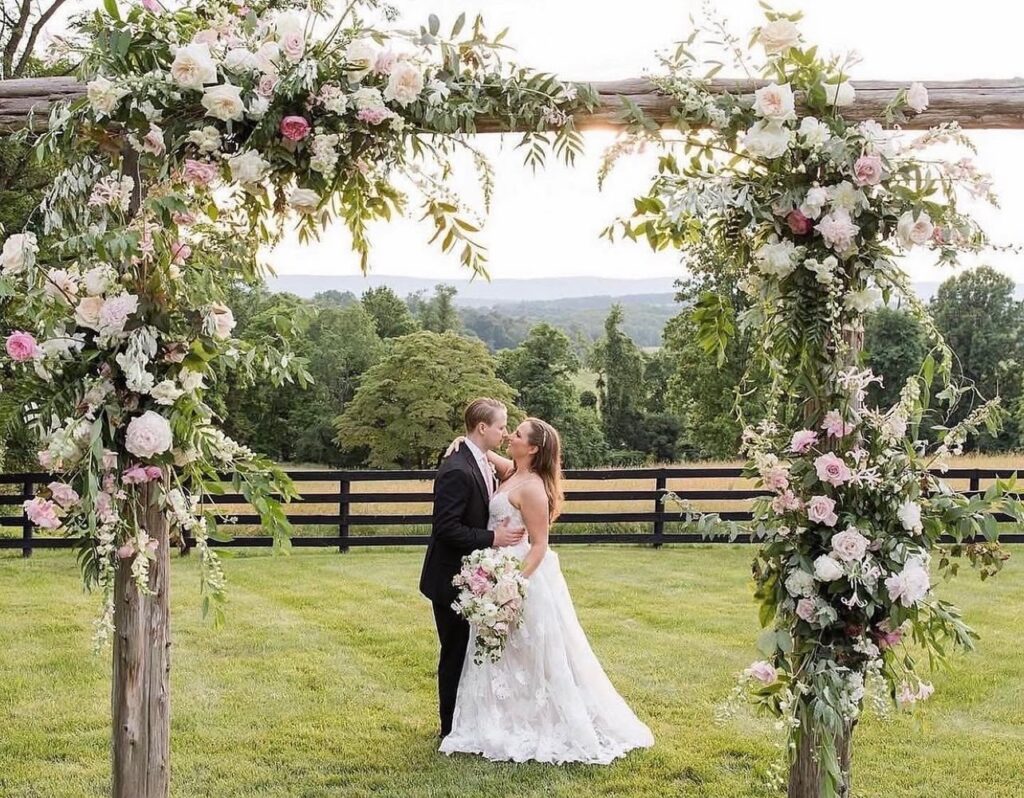
Ask any florist about sustainability challenges, and most will say arch installations are the hardest with which to be sustainable. Accent Decor reached out to eco-conscious designers such as McLeary; Amy Balsters, The Floral Coach in Alexandra, Va.; and Paulina Nieliwocki, owner of Blue Jasmine Floral in Berkeley Heights, N.J., to address the needs of florists and home florists. One of the groups’ nifty ideas is the Soprano Vase Attachment—a flared metal cup and hoop that attach to the company’s Soprano Archways. McLeary points out designing in the reusable vases can be accomplished in store or studio or on site. Accent Decor also offers similar attachment vases for its Berkshire and Gothic Archways, as well as for its Conservatory Stands, for creating “broken arch” designs, and its inventive Tenuto Stands, structures for creating elevated table designs.
“These pieces are perfect for creating a dramatic impact while providing a water source for large floral installations,” says Woods. “When we were developing these products, with insights from Sue McLeary, we focused on solving the challenge of creating floating installations without using floral foam. Achieving height with a water source at the top is difficult, but these archways and stands make it possible.”
“You want products that are meant to solve common design and waste issues without compromising style, profitability and artfulness,” adds McLeary.
Holly Heider Chapple, another notable floral designer, educator and author, owner of Holly Heider Chapple Flowers and Hope Flower Farm in Waterford, Va., and an innovator in eco-friendly design mechanics, has designed two sizes and two shapes of “Installation Mechanics”—containers that affix in a variety of ways to any arch, arbor, chuppah or other structure. “Knowing the greatest area in need of advancements was large-scale installations, we created Installation Mechanics” says Chapple, referencing her partnership with Syndicate Sales, which produces and distributes the products. “These simple containers hold up to 40 water tubes’ worth of water but can be tied onto any surface or even hung on a wall. Think of them as movable self-standing mini vases of flowers that can be hung anywhere.” But for the every day floral arranger, her frog is easiest to slip on top of a vase instead of foam.

PIN HOLDERS, TWINE AND MORE
Jennifer Reed, of Jennifer Design Events in Mullica Hill, N.J., notes that it’s an exciting time for professional and amateur florists. “There is so much information and so many resources on designing more sustainably,” she says. “My go-tos are using vessels with chicken wire, moss, branches, OshunPouches® and Sideau AgraWool®.”
Not all foam is bad. Through its subsidiary OASIS Floral Products, Smithers-Oasis North America now offers a variety of eco-friendly floral design options. Kelly Mace, CFD, AAF, PFCI, marketing manager at Smithers-Oasis, mentions OASIS® FibreFloral™ Design Media and OASIS® TerraBrick™ Floral Media as two such flower-arranging products, and she also notes that the company’s OASIS® Floral Foam Maxlife degrades 75 percent within one year in an anaerobic environment (ASTM D5511). Furthermore, Mace points to the company’s other new natural products including OASIS® Naturals BioWire, OASIS® Naturals Self-Sticking Twine, and OASIS® Naturals Bamboo Greening Pins and Bamboo Card Holders.

“In addition to those products,” Mace adds, “Smithers-Oasis North America has a line of floral containers, ECOssentials™, made of natural by-products, as well as mâché-backed floral-foam forms. Many new products released recently are made of recycled materials, with a goal of moving the company’s utility plastics to all be made of recycled materials in the near future.”
Fitz Design, a purveyor of distinctive floral accessories in Port Charlotte, Fla., has added a new line of Clear Plastic Pin Frogs to accompany its line of metal pin frogs, which includes unusual round ring pin frogs. The Clear Plastic Pin Frogs are available in round and rectangle shapes and in various sizes, and they come with suction cups that create a firm hold on most smooth surfaces. “They are quite easy to work with, and on flat smooth surfaces, the suction cups hold really well,” says floral designer and educator Patience Pickner, AIFD, PFCI, SDCF, of Sioux Falls, S.D. “In addition, the clear plastic frogs are transparent and virtually disappear in the water.” In fact, this creative floral designer has fun suctioning them to windows, mirrors and the sides of large flat-sided glass containers.
Also, kudos to Syndicate Sales for its innovative DIY Floral Grid, which enables florists and consumers to place the supportive grid structure atop the opening of a container, arrange flowers into the container through the structure and then remove it. “This inventive tool has removed all need for grid taping vases for flower arrangements,” says Derek Woodruff, AIFD, AAF, PFCI, CF, owner of Floral Underground in Traverse City, Mich., and Syndicate Sales’ lead educator and brand ambassador. “What most floral designers don’t know is that one roll of waterproof tape is 60 yards of single-use plastic,” he informs. “With the DIY Floral Grid, you simply place the grid on top of a vase to create the design and then separate and remove the two grid pieces when you’re finished, and the floral materials stay neatly in place. As a bonus, the DIY Floral Grid makes it easier for the consumer to change the water in the vase, enabling the flowers to last longer. This product is a clear winner when it comes to eliminating plastic waste.”
Brenda LaManna, the dynamic owner of Damselfly Designs in White Plains, N.Y., has also been a role model in implementing sustainable practices, especially for packaging. “Many of our retail shops are ‘grab and go,’ so packaging was an immediate and impactful area we chose to improve,” she explains. “Presentation must go hand in hand with practicality. Because many of our customers commute or travel, packaging is a necessary evil to protect the beauty of our delicate products throughout a busy day or a long journey. Our custom wax-lined water bags and handle carriers are built to be sturdy, made without harmful dyes or chemicals, and printed with soy ink, making them 100 percent recyclable and often reusable. These simple alternatives to excess plastic not only enhance the practicality of transporting delicate blooms but also extend their lifespan. The design and functionality of our eco-friendly packaging has really resonated with our customers and is now one of the signature elements of our brand aesthetic.”
Plus, because LaManna is a natural educator, her customers realize that these efforts are more costly. “Yes, eco-friendly materials are more expensive, but running a business means taking responsibility for your environmental impact,” she says. “Consumers nowadays are smart; they see through empty promises and greenwashing, and they expect the companies they support to make genuine efforts toward reducing their environmental footprint. By being transparent about our choices and staying true to sustainable practices, we’re not only doing what’s right for the planet but also building trust with a savvy audience. What’s good for the planet is good for business.”
TIME TO GET ON BOARD
Over time, more products will become available, providing greater options for eco-friendly and sustainable floral designs, which are important for growing numbers of millennial (Gen Y) and Gen Z consumers—those 43 and younger this year. As a recent Harvard University study reveals, when these two generations believe that a brand cares about its impact on people and the planet, they are 27 percent more likely to purchase a product from that brand—a clear measure of sustainability’s power to drive buying decisions in these groups. In another study, nearly three-fourths (73 percent) of Gen Z consumers (27 and younger this year) said they are willing to pay more and wait longer for eco-friendly and sustainable products. Furthermore, forecasters calculate that the purchasing power of millennials and Gen Z’ers will surpass that of baby boomers by 2030.
BRIDES WANT SUSTAINABLE WEDDINGS AND EVENTS
Carrie Rebora Barratt, Ph.D., whose stellar résumé include stints as CEO and president of the New York Botanical Garden in The Bronx and deputy director and curator of American Art at The Metropolitan Museum of Art in Manhattan, says that brides want sustainable considerations. Now director at LongHouse Reserve in East Hampton, N.Y., Barratt says clients are also seeking places where “a sustainable practice” is their mandate. “Chemical free” gardens and “natural gardens” with native plants are also selling points among brides seeking ceremony and reception venues, along with “locally” grown flowers being used. Florists with the same values would be wise to make connections with locations with eco-friendly and sustainability focuses so they will be recommended for future jobs.
With more consumers looking for environmentally responsible choices, florists and flower lovers now have increasing options, as well as stories to tell that support their commitments. Furthermore, studies reveal consumers will pay more for sustainably sourced flowers. As we say at Flowerpowerdaily, no act of love is ever wasted.
